

A New DNA-Based Strategy for Tackling Gum Disease
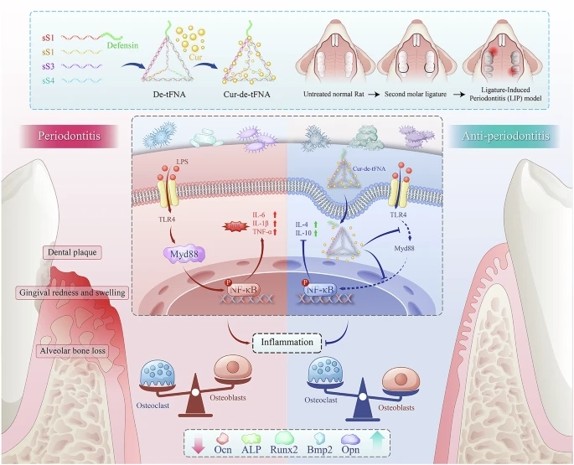
The Cur-de-tFNA DNA nanoplatform co-delivers curcumin and defensin to target periodontal bacteria, reduce inflammation, and promote bone regeneration in periodontitis.
Scientists created a multifunctional nanotherapy that aims to overcome the limitations of conventional periodontal treatments
CHINA, July 16, 2026 /EINPresswire.com/ -- Millions of people worldwide live with periodontitis, a chronic gum disease that can progressively destroy the tissues and bone supporting the teeth despite conventional treatment. Seeking a more comprehensive solution, researchers developed a novel DNA-based nanoplatform designed to deliver multiple therapeutic agents in a single package. By targeting the complex biological processes that drive the disease, this innovative approach represents a promising step toward next-generation therapies for chronic oral inflammation.Periodontitis is one of the most common chronic inflammatory diseases worldwide and a leading cause of tooth loss in adults. Triggered by bacterial plaque that accumulates beneath the gums, the disease sets off an immune response that gradually destroys the tissues and bone supporting the teeth. While treatments such as antibiotics and deep cleaning can reduce bacterial burden, they often do not fully halt disease progression or repair existing damage. These limitations have driven growing interest in therapies that can address the multiple biological processes underlying the disease.
With this goal in mind, a research team from Sichuan University—led by Dr. Geru Zhang, Professor Yunfeng Lin, and Professor Xiaoxiao Cai—developed a DNA-based nanotherapy that combines several therapeutic functions within a single platform. “We aimed to create a multifunctional DNA nanoplatform capable of delivering both curcumin and the antimicrobial peptide defensin directly to periodontal tissues, with the goal of overcoming the limitations of existing therapies,” shares Dr. Zhang. By packaging both compounds into a DNA nanostructure, the team sought to create a more comprehensive approach to treating periodontitis. The study was published in Volume 18 of the International Journal of Oral Science on April 29, 2026.
To evaluate the platform, the researchers engineered a DNA nanocomplex known as Cur-de-tFNA by loading curcumin and defensin onto tetrahedral framework nucleic acids (tFNAs). They characterized its physical properties, stability, and drug-loading efficiency before testing its performance in human periodontal ligament stem cells (PDLSCs). The complex’s antibacterial activity was tested against major periodontal pathogens, while its anti-inflammatory, antioxidant, and bone-regenerative effects were evaluated in lipopolysaccharide-stimulated PDLSCs through molecular and cellular assays. Therapeutic efficacy and safety were investigated in a rat model of periodontitis using imaging, histological analyses, and molecular assays.
The results showed that the Cur-de-tFNA nanocomplex effectively tackled several hallmarks of periodontitis. It demonstrated potent antibacterial activity against key disease-causing microbes, suppressed oxidative stress and inflammatory signaling by inhibiting the TLR4/NF-κB pathway, and promoted the expression of proteins involved in bone formation. In rats with periodontitis, treatment reduced alveolar bone loss, limited inflammatory damage, decreased osteoclast activity, and enhanced collagen deposition and new bone formation. Across multiple experiments, the combined nanotherapy consistently outperformed its individual components.
A major strength of the platform lies in its integrated design. “The DNA carrier enhanced the stability and cellular uptake of curcumin while protecting defensin from degradation, allowing both therapeutic agents to function more effectively,” shares Prof. Lin. Prof. Cai adds, “As a result, the nanoplatform delivered stronger antimicrobial activity, better control of inflammation, and improved preservation of periodontal tissues in preclinical models.” Moreover, because it is biodegradable and composed entirely of natural nucleic acids, the carrier exhibited excellent biocompatibility and a favorable safety profile, further supporting its potential for future clinical applications.
Although the findings are currently limited to laboratory and animal studies, they point toward a promising new direction for periodontitis therapy. Following further validation in larger animal models and human clinical trials, multifunctional DNA nanoplatforms such as Cur-de-tFNA could offer treatments that not only suppress disease progression but also help regenerate damaged periodontal tissues. The same strategy may eventually prove valuable for other disorders involving chronic inflammation, bacterial infection, and bone loss.
Overall, this study highlights the promise of a multifunctional DNA nanomedicine capable of simultaneously targeting bacterial infection, chronic inflammation, and bone destruction—the three hallmarks of periodontitis. By enhancing the delivery and effectiveness of curcumin and defensin, the Cur-de-tFNA platform offers a compelling proof of concept for more holistic management of periodontitis and potentially other inflammatory diseases.
Reference
Title of original paper: DNA framework-based nanomedicine platform: a triple-function strategy for treating periodontitis via antibacterial, anti-inflammatory, and osteogenesis-promoting activities
Journal: International Journal of Oral Science
DOI: https://doi.org/10.1038/s41368-026-00439-2
About Sichuan University
Sichuan University is a research university located in Chengdu, China, and widely recognized as one of the country’s leading higher education institutions. It was formed through the merger of several historic universities, including the former West China University of Medical Sciences, giving it a strong foundation in medical and health sciences. The university offers a broad range of disciplines across medicine, engineering, natural sciences, humanities, and social sciences. Its West China medical campuses, particularly the West China Hospital of Stomatology, are internationally recognized for dental and biomedical research. Sichuan University is part of China’s elite “Double First-Class” initiative.
Website: https://en.scu.edu.cn/
About Dr. Geru Zhang from Sichuan University
Dr. Geru Zhang is a researcher affiliated with Sichuan University, with work associated with the West China Hospital of Stomatology and the State Key Laboratory of Oral Diseases. He has authored or co-authored approximately 18 peer-reviewed publications over several years of research experience, focusing on DNA nanotechnology, biomaterials, regenerative medicine, drug delivery systems, and oral disease therapeutics. His research has contributed to the development of tetrahedral framework nucleic acid (tFNA)-based platforms for applications such as periodontitis treatment, wound healing, and nasal-to-brain drug delivery.
Funding information
This study was supported by the National Natural Science Foundation of China (82370929), National Natural Science Fund for Young Scientists Fund Program C (82501707, 82501232), the General Program of the China Postdoctoral Science Foundation, the Postdoctoral Fellowship Program of CPSF under Grant (GZC20251341). the Sichuan Science and Technology Program (2022NSFSC0002), the Sichuan Province Youth Science and Technology Innovation Team (2022JDTD0021), the Health Commission of Sichuan Province Medical Science and Technology Program, the Sichuan Province Innovative Talent Funding Project for Postdoctoral Fellows (Grant No. BX202410), the Sichuan Provincial Natural Science Youth Foundation. (Grant No.2025ZNSFSC1649), Sichuan University Interdisciplinary Innovation Fund and the Research and Development Program of West China Hospital of Stomatology, Sichuan University (RD03202302, RCDWJS2024-1).
Yini Bao
International Journal of Oral Science
+862885546461 ext.
email us here
Legal Disclaimer:
EIN Presswire provides this news content "as is" without warranty of any kind. We do not accept any responsibility or liability for the accuracy, content, images, videos, licenses, completeness, legality, or reliability of the information contained in this article. If you have any complaints or copyright issues related to this article, kindly contact the author above.
